
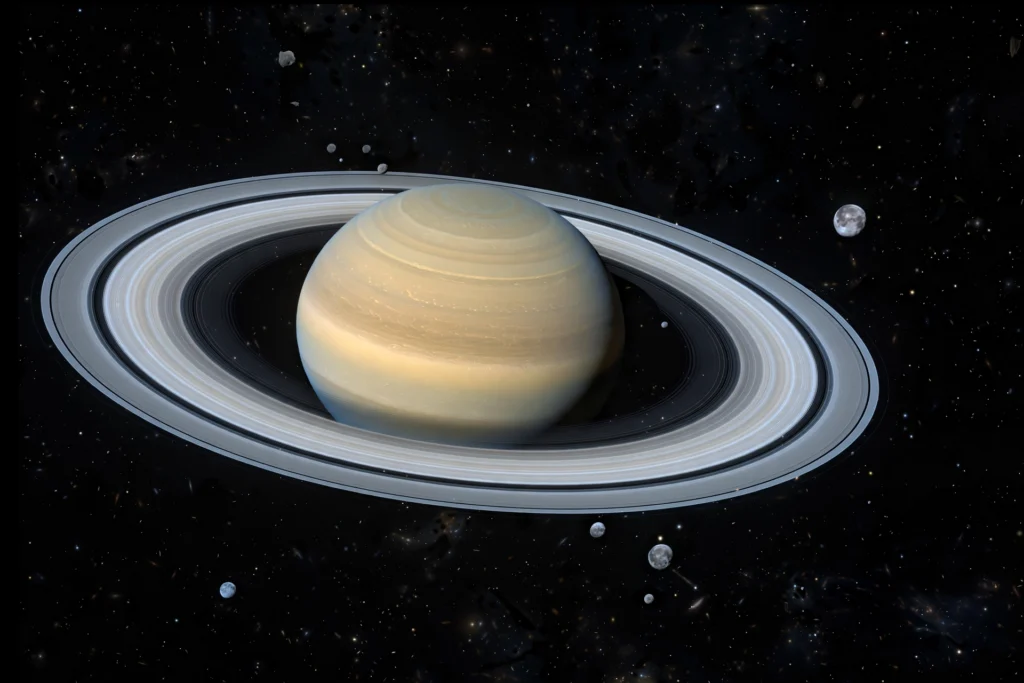
Saturn has pulled far ahead in a contest nobody designed but everybody in astronomy enjoys watching. With 128 newly confirmed moons added to its tally, the ringed planet now has 274 recognised moons, comfortably more than all the other planets combined. The previous figure was 146, which already sounded generous. The new total reframes Saturn less as a planet with companions and more as the centre of a crowded, slow-moving swarm that astronomers are only now able to catalogue properly.
Do not picture 274 versions of Earth’s Moon. The newcomers are small, irregular bodies, generally only a few kilometres wide. They keep their distance from Saturn, follow paths that tilt sharply away from the planet’s equator and, in many cases, circle in the opposite direction to Saturn’s spin. Astronomers call such objects irregular moons. Their odd orbits are a strong hint that they arrived from elsewhere rather than forming in an orderly disc around the young planet.
A telescope, a mountain and a clever trick
The observations came from the Canada-France-Hawaii Telescope, high on Mauna Kea in Hawaii. Researchers including Dr Edward Ashton of the University of British Columbia worked through deep images collected over several years, and the resulting moons have been recognised by the International Astronomical Union. Background on the observatory is available from CFHT in Hawaii, whose instruments are designed for exactly this kind of faint-object work.
The team’s technique, known as shift and stack, sounds simple and is anything but. Saturn and its distant moons move slightly against the background stars. By shifting successive exposures to compensate for that motion and stacking them, astronomers let the faint light of a tiny moon build up while random noise cancels out. Objects that would be lost in a single image gradually become measurable points. Follow-up tracking then turns those points into orbits, which is the step that separates a promising detection from a confirmed moon.
Shattered remains of captured worlds
The leading explanation for many of these bodies is dramatic. A larger moon may have been captured by Saturn’s gravity, spent ages in an unstable distant orbit and then collided with another object. The impact would scatter fragments along related paths. Over time those fragments become the families astronomers now detect, each shard preserving a little information about the size and direction of its parent. In that sense, the new catalogue is also a record of old collisions in the outer solar system.
That record matters beyond Saturn. Similar swarms probably surround the other giant planets, but they are harder to study when the planet is farther away or when the objects are even fainter. Saturn offers a comparatively accessible laboratory. If researchers can match fragment groups to collision events, they can test computer models of how captured bodies evolve. Stories on this site about everyday science, such as the study of plastic tea bags and microplastics, show the same lesson in miniature: careful measurement often reveals a busy hidden layer behind something familiar.
Why confirmation takes so long
Readers may wonder why, if the images existed over several years, the announcement arrives in one large batch. The answer is caution. A moon must be observed enough times for its orbit to be predicted reliably; otherwise it can be lost again. The International Astronomical Union’s recognition follows that painstaking work. Batch announcements also reflect how surveys operate. Teams process a field, recover candidates in later images, weed out asteroids passing through the view and only then submit the survivors as moons with secure paths.
The jump from 146 to 274 also exposes how incomplete our solar system inventory remains close to home, astronomically speaking. We can photograph galaxies billions of light-years away, yet a dark rock a few kilometres wide near Saturn can evade notice for decades. Sensitivity, sky coverage and processing power all limit what counts as known. As surveys improve, the boundary moves, and planets gain moons without anything in space having changed at all. Only our evidence has changed.
What happens next
Future work will refine the orbits, look for more members of the same fragment families and search for still smaller bodies. Some candidates may fail confirmation, while entirely new ones may emerge from archived images once researchers know where to look. For now, the headline is solid enough: Saturn has 274 moons, a total built from patient observation on Mauna Kea, image stacking and international verification. Its rings remain the famous feature, but the planet’s real entourage is far larger, stranger and more battered than the rings alone suggest. That hidden crowd is the discovery.
