
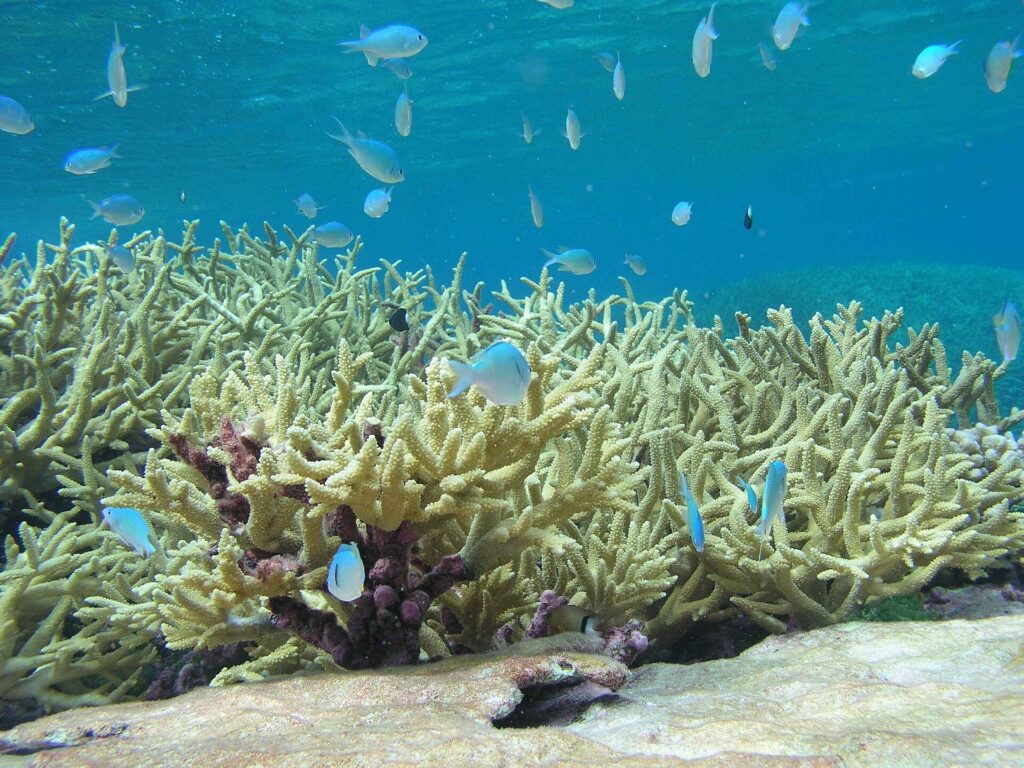
A coral reef looks like geology and behaves like a city: built by animals, inhabited by a quarter of all marine species, and — in the age of marine heatwaves — increasingly evictable by temperature. Successive global bleaching events have scorched reefs from the Great Barrier Reef to the Caribbean. Against that backdrop, a once-fringe idea has become a serious scientific enterprise: gardening the ocean, growing corals in nurseries and planting them back by the hundreds of thousands.
The gardeners’ raw material is survival itself. After each bleaching event, some corals endure — genotypes with natural heat tolerance, or microbial partners that confer it. Restoration programmes from Australia to Florida now collect these survivors, breed them (including, recently, cross-regional hybrids once considered heretical), and rear their larvae in floating nurseries before settling them onto degraded reef. Our science desk has visited the logic: evolution found the resilient corals; humans are giving them a distribution network.
The Scale Problem Is Brutal
Honesty requires the arithmetic. The world’s reefs cover hundreds of thousands of square kilometres; the most ambitious planting programmes restore hectares. Restoration cannot replant an ocean, and every practitioner knows it. The strategy, therefore, is triage and seeding: restore the sites that anchor tourism economies and fish habitat, protect the resilient ‘source reefs’ that naturally reseed their neighbours, and buy time — measured in breeding generations of heat tolerance — for emissions policy to bend the temperature curve.
Technology is attacking the scale gap. Larval reseeding — harvesting coral spawn during the annual mass spawning, rearing millions of larvae, and settling them onto degraded reef with the help of biodegradable structures — promises orders-of-magnitude gains over planting fragments by hand. Robotics and AI image surveys now map reef health at resolutions divers cannot match, directing effort where survival odds are best, as documented by programmes coordinated through the UN Environment Programme.
Gardening Is Not a Substitute
Every coral gardener says the same thing, usually while holding a fragment: this is not the solution, it is the lifeboat. Reefs planted into an ever-hotter ocean face the same bleaching roulette as wild ones; the enterprise succeeds only if the warming slows. What restoration uniquely offers is the preservation of genetic diversity and local reef function through the dangerous decades — a living library, kept wet.
The Coral’s Own Technology
The most elegant tools in the restoration kit belong to the corals themselves. Corals reproduce in synchronised mass spawning events — whole reefs releasing eggs and sperm on the same few nights of the year, cued by moonlight and temperature. Restoration science has learned to harvest that abundance: collecting spawn slicks at sea, fertilising them in floating pools, and settling the resulting larvae onto reefs in numbers that dwarf what divers can plant. A single spawning night, properly harvested, can seed more coral than a decade of fragment planting.
Genetics sharpens the harvest. By crossing corals from warmer and cooler waters, breeders are producing offspring with combined tolerances — assisted evolution, practised with the urgency of people who have read the temperature projections. Purists once flinched at moving coral genetics across regions; the bleaching maps have largely settled that argument. The ethics of intervention look different once the alternative is a reef of rubble.
Funding, inevitably, is the binding constraint. Restoration still runs largely on grants and philanthropy measured in millions, against degradation driven by forces measured in billions. The gardeners’ wager is that demonstrating recovery at site scale — visibly, measurably, in places tourists and fishers can see — is how the larger money gets persuaded.
There are worse ways to spend a scientific career than gardening the sea. And on the evidence of the newest nurseries — acres of young coral where rubble stood — the gardeners are not merely performing hope. They are manufacturing it, one settled larva at a time. More at woksip.com.
