
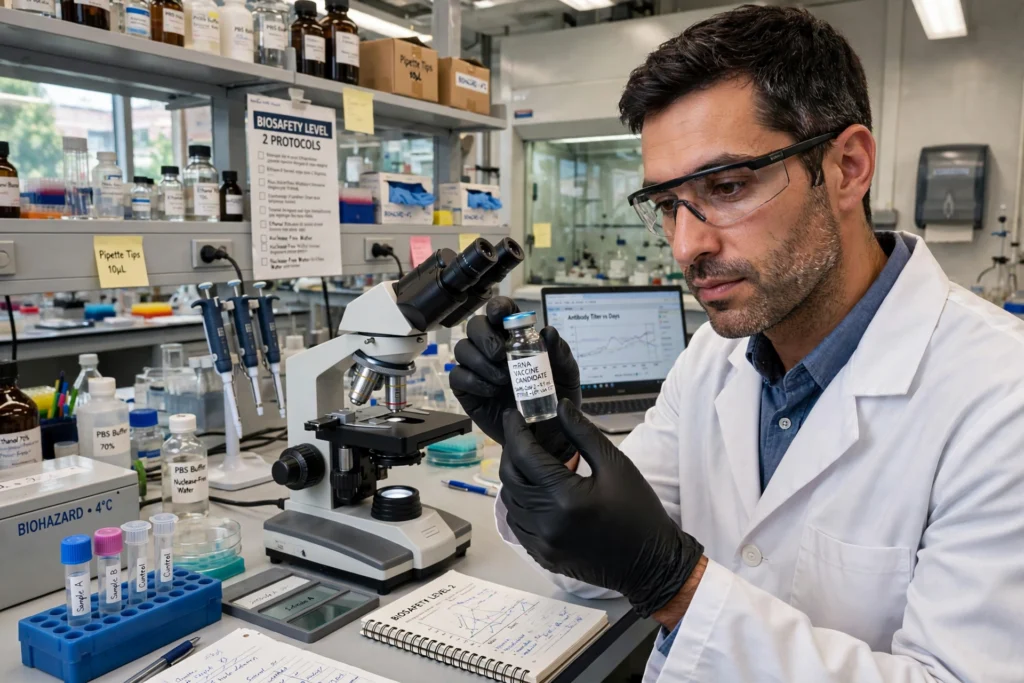
A vaccine built for one person, from that person’s own cancer, sounds like science fiction until a trial shows it can actually be produced and given in a hospital setting. That is the narrow but real achievement reported for NeoVax, a personalised neoantigen vaccine tested with nivolumab in platinum-sensitive recurrent ovarian cancer. The phase 1 results, published in Nature Medicine, focus on feasibility and safety: the vaccines were manufactured for patients, treatment could be delivered, safety was acceptable and immune responses were detected.
Those qualifiers should stay attached to every sentence about this study. Phase 1 research is an early doorway, not a verdict. It usually involves a small, carefully selected group and asks whether an idea is practical enough to justify larger testing. It does not establish that NeoVax extends survival, shrinks tumours reliably or should become standard care. Keeping that distinction clear is not pessimism. It is how readers can welcome genuine progress without being misled by it.
Building a vaccine from tumour mutations
The starting point is a sample of the patient’s tumour. Scientists search its genetic changes for mutations that create neoantigens, abnormal protein fragments not found in normal cells. Because the immune system can potentially treat those fragments as foreign, they make attractive vaccine targets. A NeoVax preparation is then designed around selected targets for that individual. The process is personalised in the literal manufacturing sense, which makes it scientifically appealing and logistically demanding at the same time.
Nivolumab, the partner drug in the trial, is a PD-1 immune checkpoint inhibitor. It blocks a signal that can restrain T cells, aiming to keep immune cells active against cancer. Combining it with a vaccine is an attempt to pair instruction with release: teach T cells which abnormal fragments to recognise, then reduce one mechanism that might hold them back. The National Institutes of Health provides general background on immunotherapy research for readers who want the wider context.
What the immune results do and do not say
Researchers reported T-cell responses linked to the vaccine approach. That is a meaningful laboratory finding because a cancer vaccine that produces no immune reaction would have little reason to continue. Yet immune activity is a step on a chain, not the final link. T cells must reach the tumour, survive in its environment, recognise the intended targets and change the course of disease. A phase 1 trial can show the first parts of that chain while leaving the clinical outcome unresolved.
This is also why recurrent ovarian cancer is a demanding test case. When the disease returns after platinum-based treatment, options may narrow and tumours can develop ways to resist therapy. Our recent article on glucose monitors, food choices and blood sugar dealt with a very different health topic, but the principle is familiar: a measurable signal is useful only when interpreted within its limits. A blood marker, like an immune assay, needs clinical evidence behind it before it can guide decisions on its own.
Manufacturing is part of the medicine
For personalised treatment, manufacturing is not a background detail. Each vaccine requires tumour analysis, target selection, production, quality checks and coordination with the patient’s treatment schedule. Demonstrating feasibility means those steps fitted together for the people in the study. Scaling that process is another challenge entirely. Cost, turnaround time, laboratory capacity and access would all matter if later trials support wider use, particularly for patients treated outside major research centres.
Safety requires the same careful reading. Acceptable in a trial report means the side effects observed were judged manageable in context and under close monitoring. It does not mean risk-free, and it does not predict tolerability for every patient with recurrent ovarian cancer, especially people with other medical problems who might not have qualified for the study. The combination with nivolumab brings the known considerations of checkpoint inhibition as well, which is one reason such work belongs in specialist hands.
The next questions
The next questions are straightforward to list and hard to answer. Can a larger, controlled study show a benefit that matters to patients? Which patients, if any, respond best? How durable are the immune responses? And can manufacturing be made faster and more consistent? Until those questions are tested, NeoVax in this setting remains an early, carefully reported experiment with encouraging feasibility results. Its publication in Nature Medicine gives other researchers the detail they need to scrutinise and build on the work. That scrutiny, not a headline, is what will decide its future.
